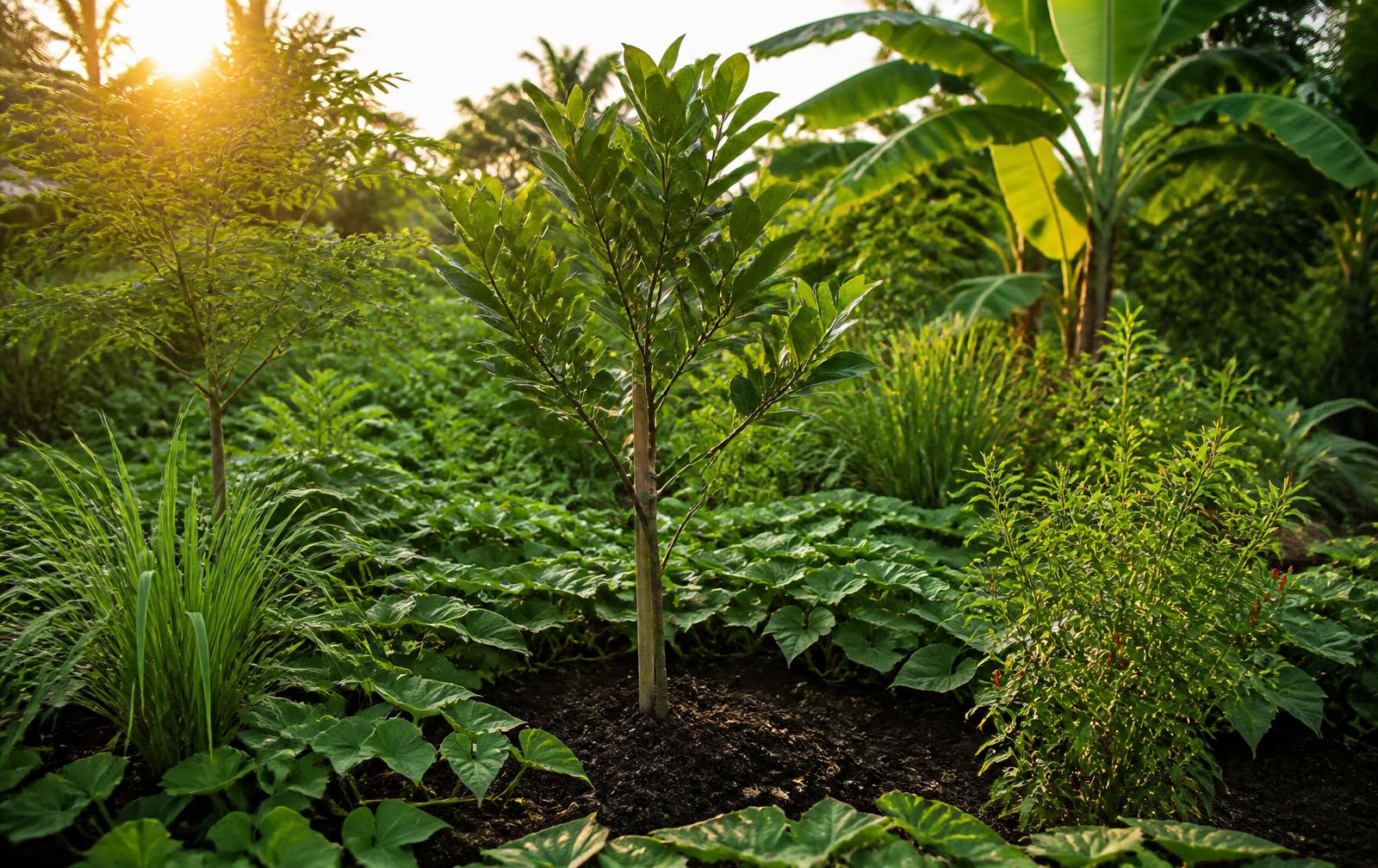
Young jackfruit tree surrounded by lemongrass, moringa and sweet potato vines in a tropical Philippine garden

The guild layout · 5 m × 5 m, Philippines

Every measurement you need to plant it this month.

No guesswork and no wasted seedlings: exact distances from the centre trunk to the outer border, layer by layer, in three affordable phases. Working with less space or more? The sizing matrix rescales the same guild to any footprint, from a patio of pots to a barangay lot.

The master layout

A center, a middle ring, and an outer border

Think of the plot as a grid built outward from one trunk. Everything else is measured from that single point.

The rule

One tree per 25 sqm

A 5 m × 5 m plot supports exactly one tree. Everything else is shrub, vine, ground cover or root. Moringa still belongs in the plot, but as a coppiced leaf shrub topped at 2 m — not as a second tree. If you want jackfruit and noni and calamansi, plant separate plots rather than crowding one.

North

Outer border: Lemongrass · Chilis · Basils · Culantro · Mint · Oregano

Your one tree

Center · 0 m

Black Pepper

0.3 m · on trunk

Winged Bean

0.3 m · on trunk

Moringa

1.5 m · coppiced 2 m

Gotu Kola

2.5 m · south shade

Pigeon Pea

2.0 m · east

Pigeon Pea

2.0 m · west

Ginger · Turmeric

2.5 m · shade

Galangal

2.5 m · shade

Winter Melon

Open floor · west

Purple Kamote

Open floor · east/south

5 m × 5 m · 25 sqm · one treeRings: 1.5 m · 2.0 m · 2.5 m from the trunk

Center trunk · your one tree

Exactly one tree on a raised mound — jackfruit, moringa, noni, papaya, calamansi or guava — with Black Pepper and Winged Bean climbing it.

Mid-ring · 1.5–2 m

Moringa north as a coppiced 2 m leaf shrub, with Pigeon Peas spaced evenly around the ring.

Canopy floor · 2.5 m

Ginger, Turmeric, Galangal and Gotu Kola in the dappled shade.

Outer border

Lemongrass, Chilis, Basils, Culantro, Mint and Oregano as a living pest barrier.

Open floor

Winter Melon crawls west; Purple Sweet Potato carpets east and south.

Measurements

Distances from the center trunk

Measure with a string tied to the trunk — swing it around like a compass to mark each ring.

0 mCenterYour one tree, on a raised mound — jackfruit, moringa, noni, papaya, calamansi or guava. Pick one only.
0.3 mAt the baseBlack Pepper vine and Winged Bean vines, climbing the trunk.
1.5 mMid-ringMoringa on the north side, kept topped at 2 m as a coppiced leaf shrub.
2.0 mMid-ringPigeon Peas, spaced evenly around the ring.
2.5 mUnder the canopyGinger, Turmeric, Galangal and Gotu Kola.
EdgesThe borderLemongrass, Chilis, Basils, Oregano and Mint.
FloorOpen groundWinter Melon crawling west; Purple Sweet Potato (Imo) carpeting east and south.

Plot variations

Three plots, one system

The skeleton never changes: one tree, one nitrogen fixer, roots in the shade, a herb border and a carpeted floor. What changes is the tree in the center and what the plot is for. Run three to five of these plots, one or two trees each, and you have variety without crowding a single square.

The fruit plot

One tree: Jackfruit · Avocado · Papaya · Banana

Household calories and fresh fruit — the plot that fills the plate first.

What changes
A heavy fruiting tree in the center — Avocado is the pick when the household needs healthy fats and a high-price fruit. Winter melon and purple kamote carry the floor, so the plot produces bulk food as well as fruit.
What it gives you
Ripe fruit for the table, and the glut dried, jarred or turned into chutney so nothing rots.

The medicine plot

One tree: Noni · Guyabano

Teas, juices and poultices — the plot the neighbourhood comes to when someone is sick.

What changes
A small medicinal tree in the center, so more light reaches the ground. Weight the roots and herbs: turmeric, ginger, gotu kola, holy basil, oregano and mint.
What it gives you
Dried leaves, fermented noni juice, salabat packs and herb bundles — light, storable and always on the shelf.

The cash-crop plot

One tree: Calamansi · Dwarf Cacao · Coffee

The kitchen staples you would otherwise buy every week.

What changes
A useful everyday tree in the center with chilis and lemongrass widened along the border, since both are picked all year.
What it gives you
Calamansi juice and syrup, chili vinegar and sawsawan, dried lemongrass — the flavours a Filipino kitchen runs on.

What stays the same in all three

One tree in the center. At least one nitrogen fixer in the mid-ring. Moringa as a coppiced 2 m leaf shrub. Ginger, turmeric and galangal in the shade. A herb and lemongrass border. A carpeted floor of kamote or winter melon so soil is never bare.

Why more plots beats more trees

Two or three plots, one tree each, and nothing goes to waste

  1. 01Plant two or three plots instead of one crowded square. Each one has its own tree and its own job.
  2. 02Feed the household first. A single 25 sqm plot already covers daily greens, roots and herbs.
  3. 03Keep what you cannot eat fresh — dried, fermented, jarred — so the pantry carries you between seasons.
  4. 04Share or swap the rest with neighbours, and save seed and cuttings for the next round.

When neighbours run different variations instead of all planting the same thing, the barangay ends up with fruit, medicine and kitchen staples between them — and plenty to swap. Whatever you cannot eat fresh gets dried, fermented or jarred.

See how the harvest is used

Step by step

Prep the ground, then plant in three phases

Each phase waits for the last one to establish, so young plants always get the light or shade they need.

01

Clear the area

Pull up weeds and grasses across the whole 5 m × 5 m square.

02

Build the center mound

Dig a hole in the exact center, 50 cm wide and 50 cm deep — this is the home of your one tree. Mix the dug-out soil 50/50 with compost or aged carabao/chicken manure and form a slight hill. The mound stops water from pooling around the main trunk during typhoons.

03

Build the kamote mounds

Where the Purple Sweet Potato (Imo) will crawl, pile loose soil into long raised ridges about 30 cm high. Sweet potatoes need loose, fluffy soil to expand their purple tubers.

The anchors & soil builders

Phase 1 · Day 1

These plants need full sun and start building shade and nitrogen immediately.

  • Your one tree — center

    Gently remove the chosen sapling from its plastic pot and plant it in the center mound. Match the soil line to the pot line, then water deeply. In the worked example this was a grafted jackfruit; a papaya, calamansi, guava or noni goes in exactly the same way.

  • Moringa seeds — 1.5 m out (as a shrub)

    Plant 3 seeds together about 2 cm deep. Once they reach hand height, keep only the strongest seedling — then top it at 2 m and keep it cut back so it stays a leaf shrub, not a second tree. Skip this step if moringa is already your one tree in the center.

  • Pigeon Pea seeds — 2 m out

    Plant seeds 3 cm deep, spaced every 1 meter around the mid-ring.

  • Winged Bean — 30 cm from the trunk

    Soak the seeds overnight, then plant 4 around the base of your tree. They will sprout and find the trunk to climb on their own.

  • Winter Melon & Chili seeds

    Start these in seed trays with potting mix. Keep them moist in partial shade for 2 weeks, until they have 4 true leaves.

The ground floor & living mulch

Phase 2 · 2–3 weeks later

Plant once your Phase 1 anchors are established.

  • Japanese Purple Sweet Potato (Imo cuttings)

    Use 20–30 cm vine cuttings. Strip the leaves off the bottom half and bury the bare stem horizontally in the raised mounds, leaving the top 3–4 leaves above the soil. Space cuttings 40 cm apart and water daily until they stand upright.

  • Winter Melon saplings

    Transplant the seed-tray saplings to the open floor with room for the vines to spread outward.

  • Lemongrass border

    Plant clumps every 1 meter along the sunny outer edge to form a pest barrier.

The shade lovers

Phase 3 · 2–3 months later

Wait until your tree and the moringa shrub have leafed out and created dappled shade.

  • Noni — only if it is your one tree

    Noni is a small tree, so it belongs in the center of its own plot rather than squeezed into a plot that already has a tree. In the medicine plot variation, plant the noni sapling on the center mound in Phase 1 instead.

  • Turmeric, Ginger & Galangal — 2.5 m out

    Dig shallow trenches 10 cm deep in the shaded zones. Lay fresh market root pieces flat with the green eyes or buds pointing up, then cover with soil and a thick layer of dried-leaf mulch.

  • Herbs & basils

    Plant Holy Basil, Thai Basil, Oregano and Mint along the semi-shaded borders. Mint prefers the wettest corner of the plot.

  • Black Pepper vine

    Plant the rooted cutting 30 cm from the trunk, opposite the Winged Bean. Tie the vine gently to the bark with soft string until it grips on its own.

Soil building

Five ways to build living soil in the tropics

Heavy clay, hard sun and hammering rain are the real obstacles — not the plants. Build the soil first and the guild looks after itself.

Lasagna gardening (sheet mulching)

  1. 1.Lay thick layers of plain, unprinted cardboard or newspaper directly over weeds to smother them, then wet it thoroughly.
  2. 2.Add a 5 cm layer of nitrogen/green material — fresh grass clippings, kitchen scraps, or raw Malunggay leaf chops.
  3. 3.Add a 10 cm layer of carbon/brown material — dried leaves, rice straw, or coco peat.
  4. 4.Repeat the alternating layers until the bed is 30–45 cm high, ending with a brown layer on top.

Why it works: It traps maximum moisture underneath, cools the earth, and rots down into rich black topsoil within 2 to 3 months.

Biochar infusion (the ancient trick)

  1. 1.Start with raw charcoal or crushed coconut shell charcoal.
  2. 2.Inoculate it first — never add raw charcoal to soil or it will suck up all your nutrients. Mix it into your compost pile or soak it in liquid manure/compost tea for 2 weeks to charge it with microbes.
  3. 3.Mix the charged biochar into planting holes and soil mounds.

Why it works: Regular compost burns up in months under the Philippine sun. Biochar behaves like a permanent coral reef underground — its microscopic pores stay for centuries, housing microbes and holding nutrients so heavy rains cannot wash them away.

The "chop-and-drop" living fertilizer network

  1. 1.Plant nitrogen-fixing shrubs — Pigeon Pea (Kadyos) and Madre de Cacao (Kakawate) — generously throughout the plot.
  2. 2.Every 2 to 3 months, hack back their leafy branches with a bolo (itak).
  3. 3.Drop the green branches directly onto the soil around your high-value ginger, turmeric and jackfruit.

Why it works: The dropped leaves blanket and cool the soil while earthworms and microbes break them into rich humus right at the root zone.

Carbonized rice hull (CRH) aeration

  1. 1.Source CRH — partially burned rice husks — from local agricultural supply stores.
  2. 2.Mix it aggressively into clay mounds at a ratio of 30% CRH to 70% native soil.

Why it works: CRH acts like tiny volcanic rocks: it shatters heavy clay, creates permanent air pockets so roots can breathe, raises soil pH, and adds vital silica that makes crops more pest-resistant.

Living mulch & cover cropping

  1. 1.Immediately blanket the ground floor with fast-growing Japanese Purple Sweet Potato (Imo) cuttings and Winter Melon (Kondol) vines.
  2. 2.Let them form a thick, overlapping green carpet across every inch of open earth.

Why it works: The living carpet is a natural sunshield. It drops soil temperature several degrees, stops the ground baking into hard brick, and keeps raindrops from hammering and compacting the structure.

The planting-mound formula

Mix this once when you build a mound and the plot starts ahead instead of behind.

50%

Native soil

Your existing backyard dirt.

20%

Vermicompost or composted cow/carabao manure

For immediate microbial life.

20%

Carbonized rice hull (CRH) or coco peat

For structural drainage and moisture retention.

10%

Inoculated biochar / crushed charcoal

For a permanent nutrient anchor.

Cheat sheet

Beginner care & maintenance

Three habits keep the whole system feeding itself.

Watering

Water everything daily through the dry season (tag-araw). In the rainy season (tag-ulan) let nature do the work — just make sure water drains away and never puddles.

The chop-and-drop trick

When the Pigeon Peas grow tall and bushy, chop off half their green branches with an itak and drop the leaves onto the soil around the Turmeric and Ginger. They rot down into free, automatic nitrogen fertilizer.

Pruning the Moringa

Once the Moringa reaches 2 m, pinch or cut off the main top branch, and keep doing it. This is what keeps it a shrub instead of a second tree: it grows wide and bushy, the superfood leaves stay within arm's reach, and your one canopy tree keeps its light.

Scaling up

From one circle to the whole acre

One guild is the unit. Everything larger is the same circle repeated, so nothing new has to be learned to grow more.

4–9 sqm

A patch or containers

Moringa or dwarf papaya over chilli, lemongrass, ginger and turmeric — a supplement to the table.

25 sqm

One full guild

The worked example on this page: one tree, five layers, enough variety to cook from every week.

50–100 sqm

Two to four guilds

Most of a four-person household's vegetables, herbs and fruit, plus a weekly surplus.

1 acre

About 35 guilds

The full build plan: circles, walkways, water, trees, garden and product volume for the two lines.

Three rules never change at any size: at least one canopy plant, at least one nitrogen fixer, and ground never left bare.

See the one-acre build plan